How to Choose the Right Down Jacket Fabric for Warmth, Weather and Wear
 Hjem / Nyheder / Industri -nyheder / How to Choose the Right Down Jacket Fabric for Warmth, Weather and Wear
  2026.10.09
 Industri -nyheder
A down jacket is only as good as the layer that holds its insulation in place. Buyers often compare fill power, baffle construction and total weight, yet the outer fabric quietly determines whether those features survive a wet afternoon, a windy ridge or a season of daily commuting. Down clusters trap warm air, but they lose loft when moisture reaches them, and a shell that lets rain or snow soak through can leave a jacket cold within minutes.
The shell fabric governs five core outcomes: wind resistance, water resistance, abrasion durability, breathability and weight. Each one trades against the others. A fabric that is extremely light may tear on a backpack strap, while a dense, heavily coated fabric may feel clammy during a steep climb. Understanding those trade-offs is the first step to choosing well, whether you are a consumer comparing jackets or a brand selecting down jacket fabric for a new collection.
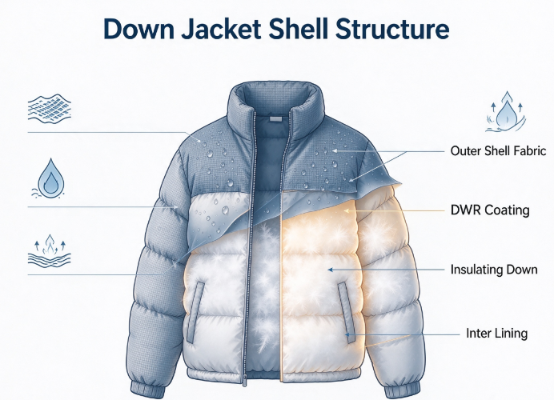
Key principle: the shell adds no warmth of its own, but it protects the insulation that does the work.
Typical denier range for down jacket shell yarns
Water resistance is usually reported as hydrostatic head, measured in millimeters
Wet down collapses, and a large share of its loft can disappear until the jacket is fully dry
For most buyers the practical question is not which fabric is best in general, but which one fits the environment and the daily wear pattern. A jacket worn on a dry, cold ski lift has very different needs from one carried through a rainy city commute.
Nearly every down jacket shell is made from either nylon or polyester filament yarns, sometimes blended or coated to reach a target performance. Both materials are durable and lightweight, but they behave differently under sunlight, moisture and mechanical stress.
| Property | Nylon | Polyester |
|---|---|---|
| Strength-to-weight ratio | Excellent | Good |
| Tear resistance at equal weight | Slightly higher | Slightly lower |
| UV resistance | Moderate | Strong |
| Color fastness | Good, can fade in sun | Excellent |
| Moisture absorption | Higher | Lower, dries faster |
| Typical fabric cost | Higher | Lower |
| Best fit | Lightweight technical jackets | Urban and everyday puffers |
Nylon is prized for its exceptional strength relative to its weight. It can be woven into very light constructions that still resist tearing, which is why it dominates ultralight packable jackets and high-performance outdoor models. Its natural softness also gives it a silky hand feel that many wearers prefer against the body.
The main drawbacks are sun exposure and cost. Nylon can degrade and fade under prolonged ultraviolet light, so jackets that will spend long summers in bright conditions benefit from UV-stable dyes or lighter colors. Nylon also absorbs more moisture than polyester, which slightly increases drying time.
Polyester offers a practical balance of performance and cost. It resists ultraviolet degradation better than nylon, holds color through repeated washing and dries quickly. For urban down jackets, where bright colors and long wear life matter more than extreme packability, polyester is often the sensible choice.
Polyester usually has slightly lower tear strength than nylon at the same weight. Designers offset this with higher denier, tighter weaves or ripstop patterns, which is why a 40D polyester shell can feel more robust in daily use than a lighter nylon alternative.
A ripstop weave adds thicker reinforcement yarns at regular intervals in a crosshatch pattern. If a small nick or tear starts, the reinforcement grid stops it from running across the full panel. Ripstop structures are common in both nylon and polyester shells because they preserve a light feel while improving resistance to tearing. They suit backcountry trips, where branches and rock edges are unavoidable, as well as everyday jackets that brush against bags or seatbelts.
Denier describes the linear mass of a yarn, meaning how heavy an individual filament is. A higher number indicates a thicker yarn, which generally brings greater abrasion resistance and a firmer feel along with more weight. Denier does not measure performance on its own, since weave density and finishing matter just as much, but it is a reliable starting point when comparing shell fabrics.
Once you know the base material and denier, the next step is evaluating how the fabric performs under water, wind, friction and movement. These metrics often appear on specification sheets, and understanding them makes options easier to compare objectively.
A durable water repellent finish, usually called DWR, is a surface treatment that makes water bead up and roll off the fabric instead of soaking in. DWR does not make a shell waterproof on its own. It slows wetting of the outer face so the fabric breathes more freely and does not turn heavy. Traditional DWR chemistries relied on long-chain fluorocarbons, but many manufacturers have moved to fluorocarbon-free formulations to meet environmental expectations and buyer requirements. These options can perform well when applied correctly, though they may need more frequent renewal.
DWR wears away through washing, friction from backpack straps and dirt buildup. A jacket that once shed rain effortlessly may start to wet out after a season, even though the membrane and fabric remain intact. This is a maintenance issue rather than a manufacturing defect, and it can be corrected with a refresh treatment.
Hydrostatic head is the standard way to express how much water pressure a fabric can resist before water passes through. Higher values indicate stronger protection. Ratings come from controlled laboratory tests, so they describe a baseline rather than a guarantee for every real-world situation.
| Hydrostatic head range | Typical performance | Suitable settings |
|---|---|---|
| Around 1000 mm | Light water resistance, handles mist and brief showers | Dry cold climates, urban wear |
| 1500 mm to 3000 mm | Good resistance to steady rain and wet snow | Three-season hiking, rainy cities |
| Above 5000 mm | Strong waterproof protection with sealed construction | Wet alpine terrain, prolonged precipitation |
Breathability describes how easily water vapor moves out of the jacket. Your body constantly releases moisture, especially during climbing, skiing or fast walking. If the shell traps that vapor, condensation builds inside the garment and the down eventually gets damp. Breathable constructions achieve this through tightly engineered weaves, microporous coatings or waterproof-breathable microporous membranes that let vapor pass while blocking liquid water.
A shell that blocks vapor turns your perspiration into internal condensation, and damp down quickly loses its loft.
For urban users with low activity levels, a moderately breathable fabric is usually enough. For active travelers, the difference between a fabric that breathes and one that does not can decide whether the jacket stays comfortable through a full day outdoors.
Abrasion resistance matters wherever a jacket rubs against something repeatedly, such as a backpack hip belt, a car seat or a rough stone wall. Laboratory rub cycle tests measure how many repetitions a surface endures before showing wear, and results correlate closely with denier, weave tightness and finish type. A dense ripstop nylon or a high-denier polyester will typically outlast a light, loosely woven fabric in the same conditions. Brands and buyers often request these test results because they reveal how a fabric will age in practice, not just how it looks when new.
Shell weight directly affects how a down jacket packs. Lightweight fabrics compress into small stuff sacks and feel almost weightless on the body, which suits travel and alpine climbs. The trade-off is durability. Pushing weight down usually means accepting a thinner surface that is more vulnerable to snags, so the right choice depends on how often the jacket will be packed, carried and abraded.
Shell fabric development has moved well beyond basic weight and strength. Today's down jacket fabric often combines several technologies to meet specific fit, sustainability and performance goals. Three developments stand out for buyers and designers evaluating a puffer jacket fabric for the next season.
Adding elastane fibers to nylon or polyester creates a fabric that moves with the body. This is valuable in active down jackets, where climbing, reaching and cycling demand freedom of movement. Elastane content is usually modest, since higher percentages can reduce wind resistance and complicate lamination. Stretch fabrics also require careful finishing so that elastic recovery stays consistent after many wash cycles.
Recycled nylon and recycled polyester yarns are increasingly requested by brands that want to reduce reliance on virgin petroleum-based materials. Recycled yarns can match the denier and tensile profile of conventional yarns, but buyers should confirm batch consistency, color matching and the documentation behind recycled content claims. Some recycled yarns also show slight differences in luster, which matters for premium collections.
Hybrid designs assign different fabrics to different body zones, placing performance where it matters most. A common approach uses a durable, water-resistant fabric on the shoulders and sleeves, a lighter and more breathable fabric under the arms and along the back, and a reinforced panel at the hem or cuffs.
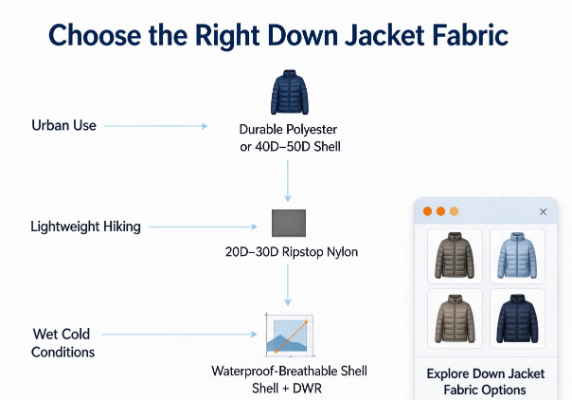
The best shell fabric is the one that fits how the jacket will actually be used. The table below summarizes typical starting points, which can then be adjusted for climate, body type and personal preference.
| Use case | Typical denier | Common fabric | Water resistance | Breathability |
|---|---|---|---|---|
| Urban commuting | 40D to 50D | Polyester, plain or ripstop | Light DWR | Moderate |
| Casual travel | 30D to 40D | Polyester or nylon | Light DWR | Moderate |
| Three-season hiking | 20D to 30D | Ripstop nylon | Moderate to good | High |
| Alpine mountaineering | 20D to 40D | Nylon with membrane | High | Very high |
Urban wearers usually prioritize abrasion resistance, color retention and a comfortable, quiet hand feel. A 40D to 50D polyester shell handles daily contact with bags, car doors and stairwells without showing early wear. A light DWR finish is generally sufficient for drizzle, slush and brief wet spells, and breathability requirements are lower because most city activity involves short walks and frequent indoor stops.
Outdoor use places greater demands on the shell. For three-season hiking, 20D to 30D ripstop nylon offers an efficient balance of packability, weight and tear resistance. In cold, wet mountain environments, a waterproof-breathable membrane with a high hydrostatic head rating becomes important, because sustained precipitation can overwhelm a DWR-only finish.
Climate and duration should guide the final choice. In humid, rainy or freezing rain regions, water resistance is the priority, and a higher hydrostatic head rating is worth the extra cost. Multi-day expeditions demand a shell that survives repeated packing, rough campsites and frequent contact with rock and branches, so a slightly heavier, more abrasion-resistant fabric is preferable. For single-day outings, a lighter fabric that compresses easily often provides the best overall experience.
Even well-engineered down jacket fabric ages prematurely without proper care. Most damage comes from over-washing, harsh detergents, high-heat drying and long periods of compression, all of which can strip coatings, weaken fibers and clump the down. The practices below help both the shell and the insulation perform for many seasons.
| Care task | Recommended approach | Avoid |
|---|---|---|
| Washing | Clean only when soiled or when loft drops, using cold water and a gentle cycle | Frequent washing, bleach |
| Detergent | Use a down-specific cleaner | Standard heavy detergents, fabric softener |
| Drying | Low heat with dryer balls to break up clumps | High heat, drying while damp |
| Storage | Hang loosely or use a breathable storage bag | Long-term compression, direct sunlight |
| DWR refresh | Reapply after washing while fabric is slightly damp, then dry on low heat | Waiting until water soaks in |
Hand washing in a bathtub is also a good option for heavily soiled jackets. Gently press the fabric, avoid wringing, and support the garment fully while it is wet.
Drying is the most critical step. Tumble dry on the lowest heat setting and add clean tennis balls or dryer balls to break up down clusters. Check the jacket periodically and feel the seams and hem. Down must be completely dry before storage, because trapped moisture encourages odor, mildew and permanent clumping that no amount of fluffing can reverse.
Store the jacket loosely, either hanging or folded in a breathable bag, in a cool and dark place. Compression in a stuff sack is fine for travel and short trips, but keeping the jacket compressed for months flattens the clusters and reduces loft. Direct sunlight also degrades DWR finishes and can fade colors in shell fabric over time.
If water still soaks in, check whether the membrane or seam tape is failing, because a DWR refresh alone cannot repair structural damage.
For apparel brands, ODM partners and fabric buyers, a down jacket shell specification should be defined before samples are produced. Clear documentation prevents disputes, supports quality control and shortens development cycles. Use the following checklist when requesting a quotation or sample.
Request physical swatches and test them under your own conditions. Sewing samples, seam sealing trials and wash cycles reveal how the fabric behaves inside the finished garment, which laboratory data alone may not show. Quality shell fabric is a system decision involving the membrane, coating, weave and cutting approach, so aligning these early saves cost later.
To compare specifications side by side, review the full range of down jacket shell fabric options and match each one against your target use case.
The questions below cover the most common points buyers and everyday wearers raise when evaluating shell materials.
Neither material is universally better. Nylon offers superior strength at low weights and suits lightweight technical jackets, while polyester provides stronger UV resistance, excellent color retention and lower cost, making it a practical choice for urban puffer jackets. Match the material to how and where the jacket will be used.
For daily urban wear, 40D to 50D offers good durability. For three-season outdoor use, 20D to 30D balances weight and toughness. Ultralight packable jackets commonly use 10D to 20D but require more careful handling around sharp objects.
DWR stands for durable water repellent, a surface finish that causes water to bead and roll off. Its lifespan depends on washing frequency, friction and dirt. Many jackets need a refresh after several washes or a season of regular use, and you will notice when water begins to soak in.
No. Waterproof describes resistance to liquid water penetration, usually measured by hydrostatic head. Breathability describes how easily water vapor escapes. Some fabrics are highly waterproof yet less breathable, while others use microporous membranes to achieve both. Active users should consider both properties.
Short-term compression for travel is acceptable, but long-term compression reduces loft. Store the jacket loosely in a breathable bag in a cool, dry place away from direct sunlight to preserve both insulation and shell coatings.
Mountaineering jackets generally use a durable ripstop nylon, often in the 20D to 40D range, paired with a waterproof-breathable membrane or a high hydrostatic head finish. Lighter options suit dry alpine conditions, while more protective constructions are better for wet, snowy environments.
Down clusters trap air to create loft. When water reaches the down, the clusters collapse and lose their ability to hold warm air, and they can take a long time to dry fully. Protecting the shell from moisture and drying the jacket thoroughly after exposure is the best way to maintain warmth.
Ripstop is a reinforced grid pattern woven into nylon or polyester fabric. Heavier reinforcement yarns placed at intervals stop small tears from spreading, adding durability without a major weight penalty. It is especially useful in outdoor shells that encounter branches, rocks and gear.
Wash only when soiled or when loft noticeably declines. Use cold water on a gentle cycle, a down-specific cleaner and no fabric softener. Close zippers and closures, rinse thoroughly, and dry on low heat with dryer balls until the down is completely dry.

Canxing Textile Building, No.458Dongxin Road, Shengze Town, Wujiang District, Suzhou City, Jiangsu -provinsen, Kina

+86-18816291909

+86-512-63620515


Copyright © Wujiang canxing Textile Co, .ltd. Rights Reserved. Brugerdefinerede elastiske vævede stoffer producenter
Privatliv 苏公网安备 32050902101422